Key takeaways
- Support online new applications and permit renewals.
- Use unified forms and digital document submission.
- Automate assessments according to applicable ordinances.
- Support authorized online payments and payment verification.
- Coordinate approvals across government offices.
- Accommodate barangay and BFP clearance requirements.
- Provide reporting, audit logs, and data protection.
- Include ongoing technical support and data portability.
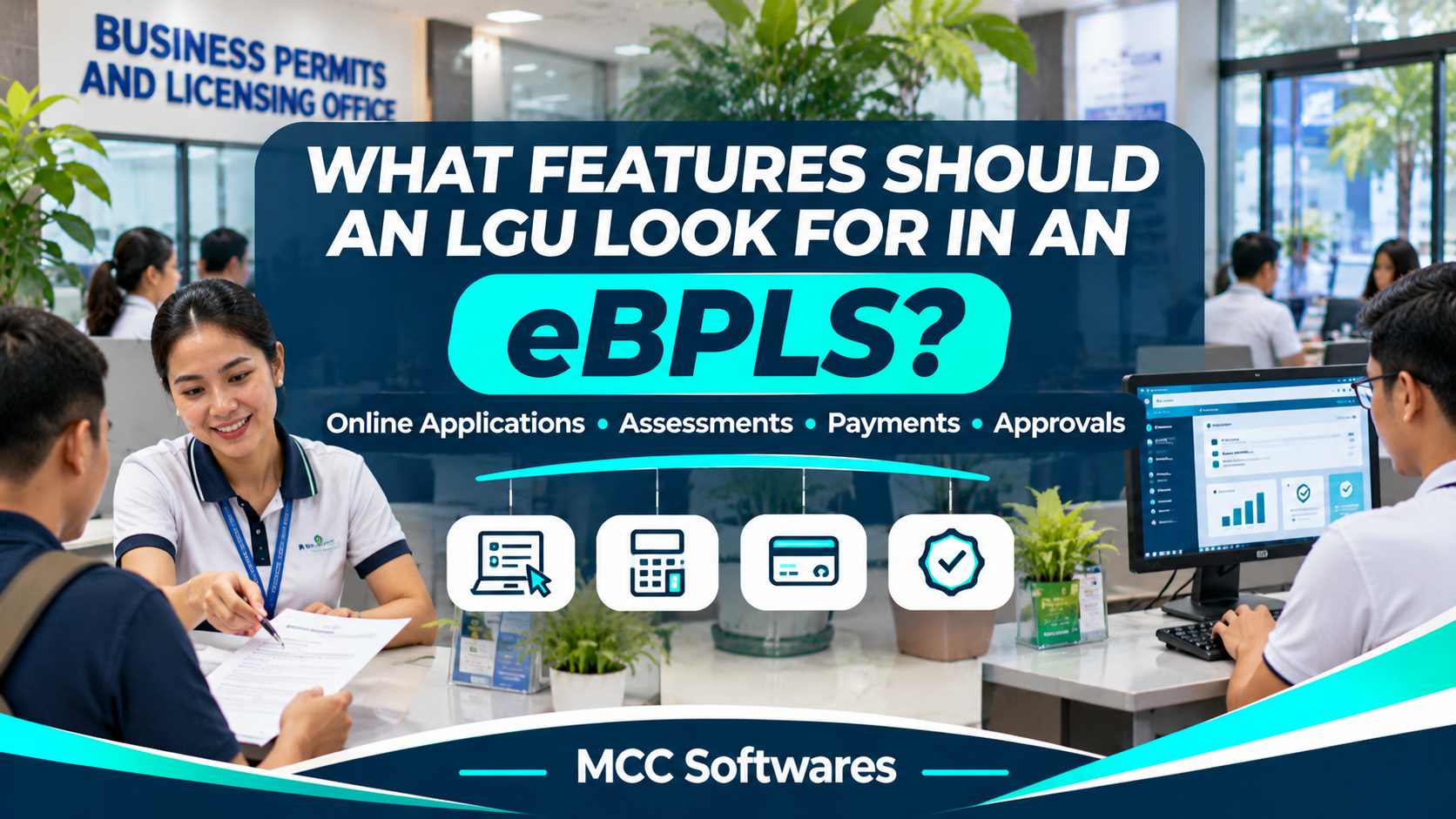
For many business owners in the Philippines, getting a business permit has traditionally meant visiting the municipal hall, submitting documents, paying fees, and following up on approvals.
An eBPLS (electronic Business Permits and Licensing System) helps local government units manage these processes digitally.
But not all systems offer the same capabilities. Some only record applications, while others support online submissions, assessments, payments, approvals, and permit issuance.
So, what should an LGU look for before choosing an eBPLS?
1. Online Business Permit Applications
An effective eBPLS should make applying for business permits more convenient.
Instead of requiring every applicant to visit the municipal hall, the system should allow business owners to submit information and supporting documents online.
Important Application Features
Look for a system that supports:
New business permit applications
Business permit renewals
Unified application forms
Uploading required documents
Application reference numbers
Tracking of application status
Under Republic Act No. 11032, Philippine cities and municipalities are required to streamline and automate business permitting through an electronic Business One-Stop Shop (eBOSS).
The goal is to simplify business registration while maintaining the necessary government approvals.
2. Automated Assessment of Taxes and Fees
Manually calculating business taxes and regulatory fees can be time-consuming, particularly during the annual business permit renewal season.
An eBPLS should support configurable assessments based on applicable local revenue ordinances.
For example, fees may depend on business classification, declared gross sales, and other legally applicable assessment factors.
Why Configurable Assessments Matter
Local government units may have different revenue ordinances and fee structures.
A system should allow authorized personnel to maintain assessment rules without requiring major software redevelopment for every approved fee change.
Assessment records should also show how amounts were calculated.
This makes transactions easier to review and helps staff explain charges to applicants.
3. Online Payment and Payment Verification
An eBPLS should support a clear payment process.
Depending on the LGU's approved arrangements, this may include electronic payment gateways, bank payments, or other authorized collection channels.
The system should distinguish between payments awaiting confirmation and payments officially recorded as received.
It should also support proper transaction references and reconciliation.
Important: A payment screenshot should not automatically be considered proof that government funds were received.
Electronic payment functionality must follow applicable government collection, accounting, and reconciliation requirements.
4. Multi-Office Approval Workflows
Business permits may involve several offices, including the Business Permits and Licensing Office (BPLO), Treasurer's Office, Zoning Office, and other authorized agencies.
An eBPLS should help these offices coordinate without repeatedly requesting the same information from applicants.
What Should the Workflow Include?
Useful capabilities include:
Role-based application review
Routing to appropriate offices
Approval and return-for-correction actions
Status tracking
Document review history
Notifications for pending tasks
The system should reflect the LGU's approved permitting process rather than introducing unnecessary approval steps.
The implementing rules of RA 11032 emphasize streamlined procedures and electronic coordination.
5. Barangay Clearance and Fire Safety Integration
An LGU should also evaluate how the eBPLS handles requirements involving barangay clearances and the Bureau of Fire Protection (BFP).
These requirements are part of the broader business permitting process.
An appropriate system should support the required information exchange, document verification, or integrations.
However, uploading a clearance document is not necessarily the same as having direct electronic integration with the issuing agency.
Ask the developer to demonstrate how each required approval works and whether any external connection has been officially authorized.
6. Electronic Business Permit Generation
Once an application is approved and the required payments are completed, the system should support authorized permit issuance.
Electronic permits may include identifying information, permit validity, authorized signatures, and appropriate verification features.
A QR code may also be useful, provided the verification process is secure and officially approved.
The eBOSS provisions of RA 11032 recognize electronic versions of permits with the appropriate authority.
7. Reports, Monitoring, and Accountability
A business permitting system should help LGU administrators understand how applications are progressing.
Useful reports include:
New and renewed business permits
Pending and completed applications
Permit processing times
Assessed and collected amounts
Business classifications
Applications returned for correction
Workloads by office or department
A dashboard can help identify processing delays and support management decisions.
For example, if applications are regularly delayed at a specific approval stage, administrators can investigate the cause.
8. Security, Audit Logs, and Data Privacy
An eBPLS handles business records, applicant details, and potentially sensitive documents.
Security should therefore be a major consideration.
Look for role-based permissions, secure authentication, audit logs, backups, and recovery procedures.
The Data Privacy Act of 2012 requires appropriate safeguards for personal information processed by public and private organizations.
An audit trail should help authorized administrators understand who accessed or changed records and when.
9. Technical Support and Long-Term Maintenance
Choosing an eBPLS isn't only about the initial software demonstration.
Ask who will handle system updates, database backups, security patches, staff training, and technical problems after deployment.
The LGU should also understand its data ownership, export options, hosting arrangements, and responsibilities if it changes software providers.
Before approval, request a demonstration of a complete permit transaction—from application submission through final issuance.
eBPLS Development by MCC Softwares
MCC Softwares is a Philippine software development company based in Cotabato City, providing custom solutions for businesses and government organizations.
Our government software development experience includes business permitting workflows and administrative management systems.
One relevant example is the LGU Datu Odin Sinsuat eBPLS initiative, whose public description includes online registration, permit renewal, document uploads, assessment, and application tracking.
LGUs evaluating an eBPLS should carefully review their workflows, existing records, applicable regulations, and technical requirements before selecting a solution.
For organizations with specialized requirements, MCC Softwares can discuss a custom software development approach based on the LGU's operational needs.
Visit MCC Softwares to learn more about our software development services.
Frequently Asked Questions
Is eBPLS mandatory for Philippine LGUs?
RA 11032 requires cities and municipalities to automate business permitting or establish an electronic Business One-Stop Shop, subject to applicable implementation rules.
Is eBPLS the same as eBOSS?
Not exactly. eBPLS generally refers to the business permitting and licensing system, while eBOSS describes the broader electronic one-stop-shop process for business-related government transactions.
Can an eBPLS work with existing LGU systems?
Potentially, yes. Integration depends on technical compatibility, approved data exchange arrangements, and access to the relevant systems.
Final Thoughts
A good eBPLS should do more than digitize business permit forms.
It should support a clear process for applications, assessments, payments, approvals, permit issuance, and reporting.
For Philippine LGUs, the best system is one that fits approved government procedures, protects information, and makes transactions easier to manage.
Planning to develop or improve your LGU's business permitting system?
Explore MCC Softwares and discuss your organization's software requirements.
Questions this article answers
- What features should an LGU look for in an eBPLS?
- What is the difference between eBPLS and eBOSS?
- Is electronic business permitting required under RA 11032?
- Should eBPLS support online payments?
- How should LGUs manage multiple approval offices?
- Can eBPLS generate electronic business permits?
- What security and reporting features should an LGU require?
Sources and references
- Republic Act No. 11032 — Lawphil
- Implementing Rules and Regulations of RA 11032 — Supreme Court E-Library
- Interagency Efforts Key to Improved eBOSS Implementation — Philippine Information Agency
- Data Privacy Act of 2012 — National Privacy Commission
- Datu Odin Sinsuat eBPLS Announcement — LGU Datu Odin Sinsuat
Topics covered
eBPLSeBOSSLocal Government UnitsMCC SoftwaresDatu Odin SinsuatBusiness Permits and Licensing OfficeAnti-Red Tape AuthorityDepartment of Information and Communications TechnologyDepartment of the Interior and Local GovernmentBureau of Fire ProtectionRA 11032Data Privacy Act of 2012
Related MCC products and services
Last reviewed for accuracy: 17 November 2026.
Related articles
-
POS vs Inventory Management: Do You Need Both Systems?
What's the difference between a POS system and an inventory management system? Learn what each does, when your business needs both, and how connected software simplifies sales and stock tracking.
-
How to Choose a Website Developer in the Philippines
Choosing a website developer? Learn how to compare portfolios, proposals, costs, ownership, SEO, and ongoing support before hiring a developer for your Philippine business.
-
Affordable Custom Software Development in Cotabato City
Planning a custom system in Cotabato City? Learn how to compare proposals, prioritize features, budget for support, and explore MCC Softwares solutions for your organization.