
Key takeaways
- Validate repeat demand before committing to property or construction.
- Allow space beyond the marked court for safe play and amenities.
- Get site-specific quotations and confirm local permit requirements.
- Model revenue using paid occupancy, not fully booked schedules.
- Set clear booking, payment, cancellation, and weather policies.
- Evaluate DinkPOS for court booking, POS, inventory, and reporting.
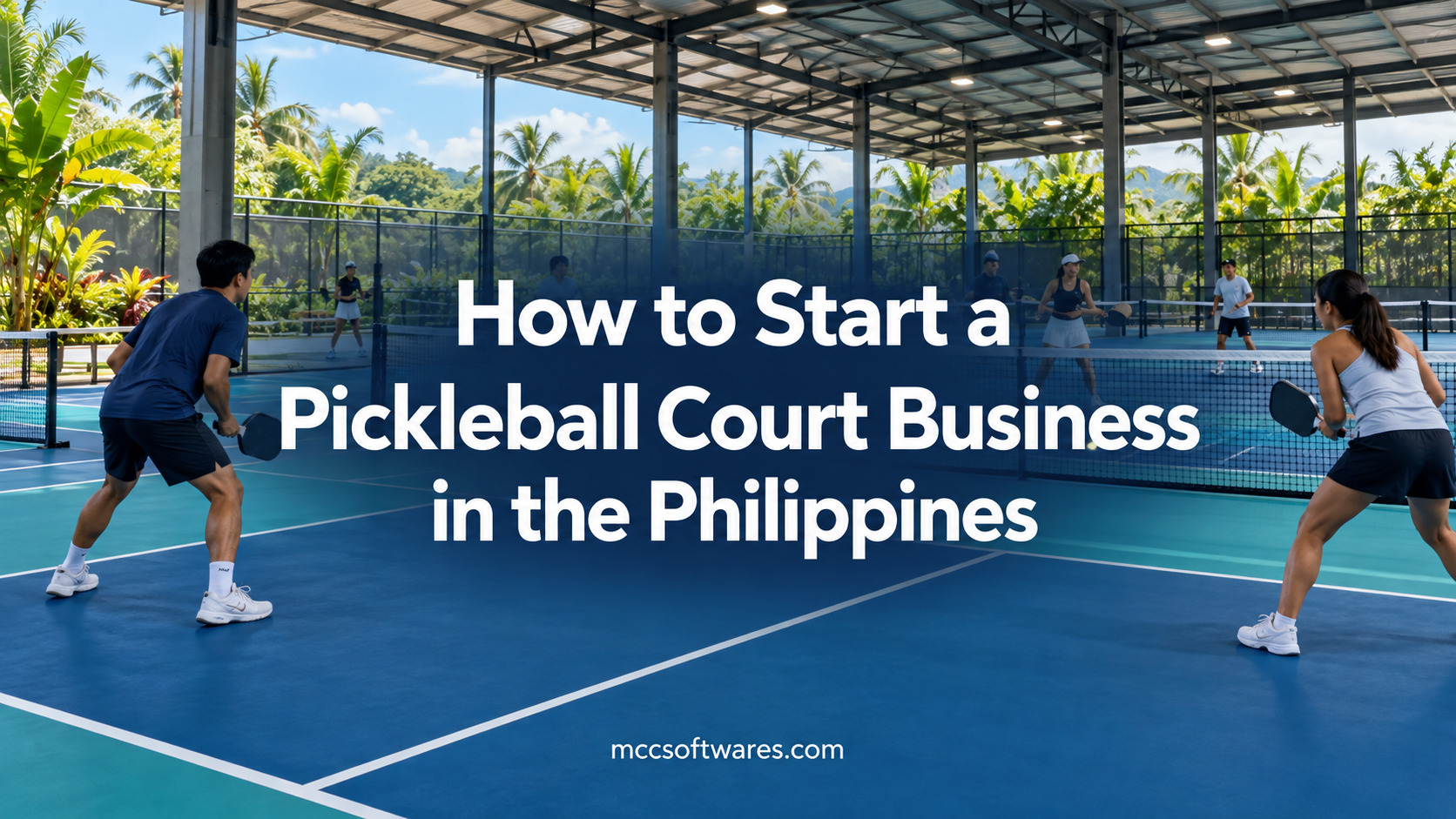
Starting a pickleball court business in the Philippines begins with validating local demand, finding a suitable site, and calculating whether realistic bookings can cover your costs. You also need the appropriate registrations and permits, a safe court layout, and a reliable process for reservations and payments.
Before committing to construction, build a plan around the players you can serve regularly. A busy opening weekend is encouraging, but repeat bookings and controlled expenses are what keep the facility operating.
1. Validate demand before signing a lease
Begin with the communities within practical travelling distance of your proposed location. Talk to local players, coaches, schools, workplaces, and sports groups. Ask when they play, how far they travel, what they currently pay, and what would make them switch venues.
Visit nearby courts at different times. Record their public rates, available facilities, booking process, and apparent busy periods. Do not assume one full evening means the local market can support another facility all week.
Use a short interest form to collect preferred schedules and contact details voluntarily. If possible, test demand through properly arranged sessions at an existing venue before taking on a long lease.
Choose your main customer and business model
Possible models include private hourly rentals, scheduled open play, coaching sessions, and group events. Each uses court time differently. Open play needs a capacity limit and rotation process; private bookings need clear start and end times.
Choose one core offer first. Add memberships or tournaments only when you understand demand, staffing needs, and the effect on regular customers.
2. Check whether the location can support the business
A suitable property must accommodate the courts, player circulation, toilets, reception, and other necessary facilities. Assess access, parking or drop-off arrangements, drainage, electricity, ventilation, and nearby residences.
Ask the relevant local offices whether the proposed activity and planned construction are allowed before making a binding commitment. For rented properties, clarify permission for alterations, responsibility for repairs, rent increases, renewal terms, and what happens to your improvements when the lease ends.
Compare outdoor and covered courts
An outdoor court may avoid the expense of a roof, but your operating plan must account for rain, heat, wind, and drying time. A covered facility adds structural and maintenance considerations and still needs attention to ventilation and wind-driven rain.
Discuss ball-impact noise and evening lighting with your designer early, especially near homes. A cheaper site can become expensive if operating hours or necessary mitigation make the business model unworkable.
3. Allow enough space for safe court design
The 2026 USA Pickleball Official Rulebook, Section 3.A, distinguishes the marked court from the larger playing surface around it:
| Layout element | Dimensions |
|---|---|
| Marked court | 20 × 44 feet, approximately 6.10 × 13.41 metres |
| Minimum playing surface, including surrounding space | 30 × 60 feet, approximately 9.14 × 18.29 metres |
| Recommended playing surface for new construction | 34 × 64 feet, approximately 10.36 × 19.50 metres |
Do not treat the marked court dimensions as the complete land requirement. Add space for circulation, seating, amenities, and site-specific requirements. These sports dimensions do not replace Philippine building approvals or professional site design.
Have qualified professionals assess the base, surface, drainage, lighting, structural work, and accessibility. USA Pickleball’s construction guidance also recommends a north–south orientation for outdoor courts to reduce problems from low-angle sunlight.
4. Build a budget from site-specific quotations
There is no single construction price that fits every pickleball facility in the Philippines. Converting a suitable existing surface is a different project from developing land or building a roofed venue.
Request itemised quotations based on the same drawings and scope so you can compare suppliers fairly.
| Budget area | Items to include |
|---|---|
| Property | Lease deposit, advance rent, or land acquisition |
| Professional work | Surveys, design, engineering, and application-related costs |
| Court construction | Groundwork, base, drainage, surfacing, markings, nets, and fencing |
| Building and utilities | Roof where planned, lighting, wiring, ventilation, water, and toilets |
| Opening equipment | Paddles, balls, seating, cleaning tools, reception equipment, and signage |
| Operating reserve | Payroll, rent, utilities, maintenance, software, and marketing during the ramp-up period |
| Contingency | Unexpected site conditions, delays, and changes in material costs |
Separate one-time setup costs from recurring expenses. Test how long your available cash can support the facility if bookings grow more slowly than expected.
5. Confirm registrations and permits for your location
Treat registration and site approval as separate workstreams. The DTI registration overview identifies DTI business-name registration for sole proprietorships and separate local business permitting. Corporations and partnerships can consult the SEC company registration portal.
Ask your city or municipal Business Permits and Licensing Office for the current checklist for your exact activity and address. Confirm barangay requirements, zoning or locational clearance, construction and occupancy approvals, sanitary requirements, and any additional permissions triggered by food service or other activities.
Discuss fire-safety requirements with the local Bureau of Fire Protection office. Its Citizen’s Charter describes the Fire Safety Inspection Certificate in connection with business permitting.
For tax registration, consult the BIR NewBizReg guidance and your Revenue District Office. Confirm your applicable registrations, books, invoices, and filing obligations with your accountant. If hiring staff, also check employer registration and employment requirements before onboarding.
Requirements and processing arrangements depend on the project and jurisdiction. Obtain the current local checklist rather than treating this overview as a complete permit list.
6. Set prices using realistic occupancy assumptions
Court-rental revenue depends on the hours customers actually book. Model slower weekdays separately from evenings and weekends, and subtract closures or maintenance time from your available hours.
Illustrative monthly revenue calculation
The figures below are planning assumptions only, not Philippine market rates or an earnings forecast:
| Assumption | Example |
|---|---|
| Courts | 2 |
| Available hours per court per day | 10 |
| Operating days per month | 30 |
| Total available court-hours | 600 |
| Paid occupancy | 40% |
| Paid court-hours | 240 |
| Average realised rental rate | ₱400 per court-hour |
| Gross court-rental revenue | ₱96,000 per month |
At the same assumed rate and capacity, 25% occupancy produces ₱60,000, while 60% produces ₱144,000. These amounts are revenue before operating costs, financing, taxes, and recovery of the initial investment.
A useful operating break-even calculation is:
Required paid court-hours = monthly fixed operating costs ÷ (average revenue per paid court-hour − variable cost per paid court-hour).
For example, assumed fixed costs of ₱80,000 and a ₱350 contribution per paid hour require about 229 paid court-hours. With 600 available hours, that is roughly 38.2% occupancy. This simplified example excludes startup-cost recovery and financing; add those cash requirements to a separate funding plan.
Consider paddle rentals, coaching arrangements, and refreshments as separate revenue streams. Calculate their actual margin and avoid counting the same court-hour twice when modelling lessons or events.
7. Set up bookings, payments, and daily controls
Write down the operating rules before opening: booking duration, payment deadlines, cancellations, rain interruptions, rescheduling, late arrivals, no-shows, and overtime. Display the policies before customers pay.
Use one booking record across online inquiries, walk-ins, and staff reservations. Reconcile payments against bookings and actual collections. A screenshot of a payment should trigger verification, rather than automatic confirmation without checking the transaction.
Where DinkPOS fits
DinkPOS is MCC Softwares’ pickleball business management product. The MCC Softwares product overview lists court booking, point of sale, inventory, and sales reports among its capabilities.
When evaluating DinkPOS, test your own daily scenarios: reserve a court, record a sale, check inventory, and review the day’s results. Confirm current plans, supported workflows, and device requirements before choosing your setup.
If your facility has requirements outside an existing product’s scope, MCC Softwares’ custom software development service can help assess a tailored system. Agree on scope and integration requirements before assuming a feature is included.
8. Launch gradually and measure repeat business
Start with a controlled soft opening after the necessary approvals and site checks. Invite a manageable number of players and test booking confirmation, check-in, session turnover, payments, cleaning, and closing procedures.
For promotion, use clear location information, real facility photos, published rates, and an easy booking link. Build relationships with nearby communities and coaches, and invite honest customer feedback after sessions.
Review these measures each week:
- Paid court-hours and occupancy by time slot.
- Average realised revenue per booked hour.
- Cancellations, no-shows, and refunds.
- Repeat bookings and customer complaints.
- Rental and retail margins.
- Operating expenses, maintenance needs, and cash balance.
Expand only when the evidence supports it. Consistently unavailable peak slots may justify testing new hours or more courts, while quiet daytime periods may call for a different programme or pricing approach.
Frequently asked questions
How much does it cost to start a pickleball court business in the Philippines?
The total depends on the property, court count, site condition, roof, amenities, and working capital. Obtain site-specific quotations and prepare a cash-flow plan. The revenue example in this guide is not a construction-cost estimate.
Can I convert an existing basketball court or warehouse?
Possibly, but usable dimensions alone are insufficient. Check surface condition, run-off space, columns, overhead clearance, ventilation, noise, access, and the approvals required for the proposed use. Have qualified professionals inspect the property before committing.
Is a pickleball court business profitable?
It can be, but profitability is not guaranteed. Compare realistic paid occupancy and contribution margins with rent, staffing, maintenance, utilities, financing, and other costs. Test a low-demand scenario before investing.
Do I need booking software before opening?
A small operation can start with a carefully controlled shared calendar and payment log. Dedicated software becomes more useful as courts, staff, bookings, and retail transactions increase. Test the full customer journey before launch, whichever method you choose.
Plan the facility and its daily operations together
A workable pickleball business combines local demand, a suitable site, realistic finances, and consistent customer service. Design the booking and payment process alongside the courts so staff can run the facility confidently from opening day.
Preparing your booking and POS setup? Contact MCC Softwares to discuss DinkPOS and the operational requirements of your planned facility.
Questions this article answers
- How do I start a pickleball court business in the Philippines?
- How much space does a pickleball court need?
- What should a pickleball facility startup budget include?
- Which registrations and local permits should I check?
- How can I estimate rental revenue and operating break-even?
- Can I convert a basketball court or warehouse?
- How can DinkPOS help manage a pickleball facility?
- Is a pickleball court business profitable?
Sources and references
- 2026 USA Pickleball Official Rulebook — USA Pickleball
- Pickleball Court Construction, Lighting & Shading — USA Pickleball
- FAQs — Department of Trade and Industry
- SEC eSPARC — Securities and Exchange Commission
- BIR NewBizReg — Bureau of Internal Revenue
- BFP Citizen’s Charter — Bureau of Fire Protection
- MCC Softwares Product Overview — MCC Softwares
- Custom Software Development Philippines — MCC Softwares
Topics covered
PhilippinespickleballUSA PickleballDepartment of Trade and IndustrySecurities and Exchange CommissionBureau of Internal RevenueBureau of Fire Protectionlocal government unitsMCC SoftwaresDinkPOS
Last reviewed for accuracy: 3 November 2026.